
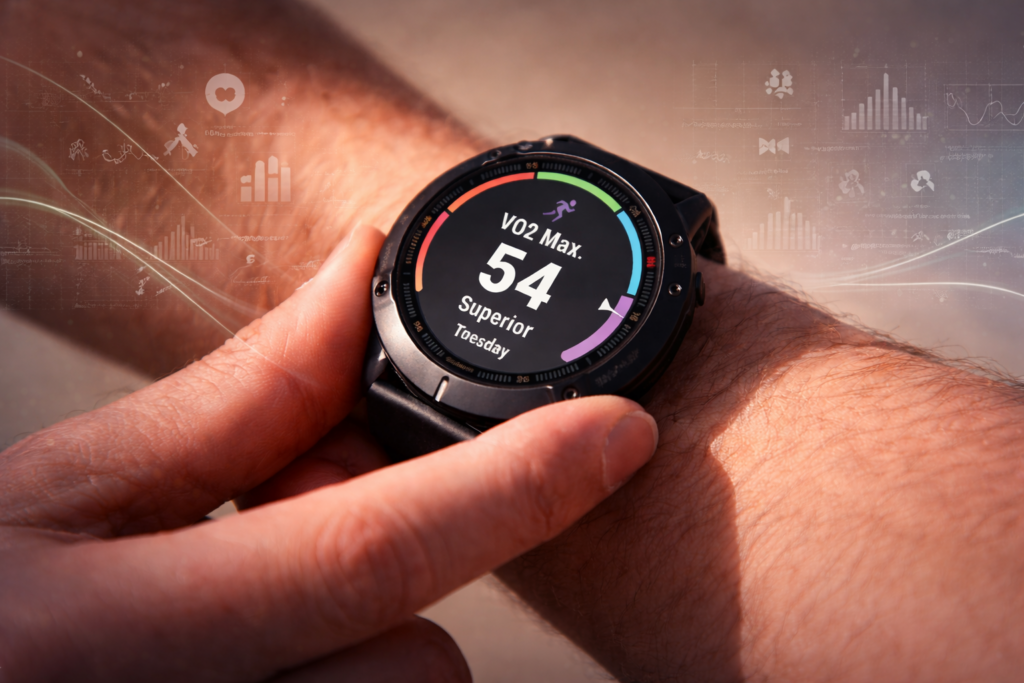
Ever wonder where those calorie estimates come from on your bike computer or fitness watch? Most devices rely on generic formulas based on your weight, heart rate, or power output. But here’s the problem: your metabolism isn’t generic. Two cyclists of the same weight riding at the same heart rate can burn wildly different amounts of energy—and more importantly, they’re burning different ratios of fat versus carbohydrate.
This is where VO2 testing comes in. A VO2 test creates your personal metabolic profile, showing exactly how your body produces energy at different intensities. When combined with activity data from your rides or runs, this profile enables precise calculations of total energy expenditure and fuel utilization—not population averages, but your numbers.
In this post, I’ll explain what VO2 testing measures, why it matters for endurance athletes, and how we use this data in the .Fit Metrics to provide personalized energy and nutrition analysis. Whether you’re trying to optimize your race-day fueling or just curious about the science, understanding VO2 testing can transform how you approach training and nutrition.
Understanding VO2 Testing
VO2 stands for Volume of Oxygen consumed. A VO2 test measures the rate at which your body uses oxygen during exercise—typically expressed as milliliters of oxygen per kilogram of body weight per minute (ml/kg/min).
During a VO2 test, you’ll exercise on a treadmill or bike trainer while wearing a mask that measures the gases you breathe in and out. The test typically follows an incremental protocol: you start easy and the intensity gradually increases every few minutes until you reach exhaustion.
What Gets Measured
The metabolic cart connected to your breathing mask tracks several key metrics:
- Oxygen consumption (VO2): How much oxygen your muscles use to produce energy
- Carbon dioxide production (VCO2): The CO2 you exhale as a byproduct of metabolism
- Respiratory Exchange Ratio (RER): The ratio of VCO2 to VO2, which reveals whether you’re burning primarily fat or carbohydrate
- Heart rate correlation: Your HR at each intensity level, creating a profile of your cardiovascular response
- Caloric expenditure: Total energy burned and the breakdown between fat and carbohydrate oxidation
What the Numbers Mean
VO2 max is the maximum rate at which your body can consume oxygen during all-out effort. It’s often cited as a measure of aerobic fitness, but it’s just one data point. For endurance athletes, what happens below VO2 max is often more important.
Substrate utilization refers to the mix of fuel sources (fat vs carbohydrate) your body uses at different intensities. At lower intensities, you burn more fat. As intensity increases, you shift toward burning more carbohydrate. Your test results show exactly where these transitions occur for your metabolism.
Metabolic efficiency varies between individuals. Some athletes are “fat burners” who can sustain higher intensities while still oxidizing significant fat. Others shift to carbohydrate earlier. Neither is inherently better—they’re just different metabolic profiles that require different fueling strategies.
The Personalization Advantage
Generic calorie formulas assume you’re average. But metabolic efficiency during exercise varies by 20-30% between individuals, even among trained athletes. This means two cyclists of identical weight riding at identical heart rates could burn 400-600 calories per hour—or they could burn 700-800. That’s not a rounding error; that’s the difference between bonking and finishing strong.
Why Generic Formulas Fall Short
Most fitness devices and apps use equations like:
- Heart rate-based: “75kg male at 150 BPM = 650 kcal/hour”
- Power-based: “200 watts × 3.6 = 720 kcal/hour”
- Speed/pace-based: “Running 10 km/h = 600 kcal/hour”
These formulas provide ballpark estimates, but they miss critical individual variation:
- Your muscle fiber composition affects efficiency
- Your training state changes how you metabolize fuel
- Your genetics influence substrate utilization
- Your heat acclimatization affects energy cost
- Your pedaling/running economy matters
What You Learn From Your Test
A VO2 test gives you actionable insights:
- Your fat-burning capacity: At what heart rate do you maximize fat oxidation? This defines your “all-day pace” for ultra-endurance events.
- Carb utilization at race pace: How many grams of carbohydrate per hour do you burn at your target intensity? This tells you exactly how much fuel to carry.
- Personalized training zones: Instead of generic percentages, you know your actual metabolic thresholds.
- Efficiency tracking: Retesting over time shows if training is improving your metabolic efficiency.
Real-World Applications
Nutrition planning: Stop guessing how many gels to bring. If you know you’ll burn 300g of carbohydrate in a 4-hour ride, you can plan to consume 240g (accounting for ~80g liver glycogen depletion).
Pacing strategy: Ultra-distance athletes can identify their maximum sustainable pace before carbohydrate depletion becomes a limiting factor. Stay below this threshold, and you can ride all day on fat and minimal carbs.
Training zone optimization: Design training sessions that target specific metabolic adaptations. Want to improve fat oxidation? Train at the heart rate where your RER shows 50/50 fat/carb split.
Performance tracking: Retest annually to see if training improved your efficiency. A 5% improvement in fat oxidation capacity at threshold pace could mean the difference between bonking and winning.
From Lab Test to Activity Analysis
Having VO2 test data is valuable, but making it actionable is where the real power lies. This is what the .Fit Metrics does: it takes your lab test results and applies them to every ride or run you upload, giving you precise energy and fuel breakdowns.
Step 1: Your VO2 Profile
After your test, you’ll receive a detailed report. The key data points you need are typically 8-10 measurements taken at different heart rates throughout the test. Each measurement includes:
- Heart rate: Your HR at that stage (e.g., 124 BPM)
- Total kcal/hr: Total energy expenditure (e.g., 694 kcal/hr)
- Fat kcal/hr: Calories from fat oxidation (e.g., 416 kcal/hr)
- CHO kcal/hr: Calories from carbohydrate oxidation (e.g., 243 kcal/hr)
You enter these data points into your Athlete Profile, creating a personalized metabolic curve. Here’s an example of what that data looks like:
| Heart Rate (BPM) | Total (kcal/hr) | Fat (kcal/hr) | CHO (kcal/hr) |
|---|---|---|---|
| 124 | 694 | 416 | 243 |
| 131 | 784 | 393 | 352 |
| 139 | 860 | 375 | 442 |
| 144 | 921 | 372 | 503 |
| 150 | 1006 | 279 | 676 |
| 154 | 1077 | 164 | 859 |
| 160 | 1115 | 68 | 992 |
Step 2: Heart Rate Matching
When you upload a FIT file from your ride, the analyzer reads every heart rate record—typically one measurement per second. For a 3-hour ride, that’s 10,800 data points.
Each heart rate value gets matched to your VO2 profile. If your heart rate at second 1,247 was 142 BPM, we look at your profile and interpolate the energy expenditure for that specific heart rate. This accounts for the fact that you weren’t tested at precisely 142 BPM, but we have data points around it (139 and 144 BPM in the example above).
Step 3: Second-by-Second Calculation
For each second of your activity, we calculate:
- Total kcal/hr at that heart rate (interpolated from your profile)
- Fat kcal/hr at that heart rate (interpolated from your profile)
- Carb kcal/hr at that heart rate (interpolated from your profile)
- Convert to kcal/second (divide by 3,600)
- Sum across the entire activity
This second-by-second approach captures the reality of variable-intensity exercise. Your heart rate fluctuates constantly during a ride—climbing, descending, accelerating, recovering. By calculating at each moment rather than using an average, we get far more accurate total energy expenditure.
Step 4: Results You Can Use
The analyzer displays:
- Total energy burned: Complete caloric expenditure for the activity
- Grams of carbs burned: Divide carb kcal by 4 to get grams (4 kcal per gram of carbohydrate)
- Grams of fat burned: Divide fat kcal by 9 to get grams (9 kcal per gram of fat)
- Power-based comparison: If your file includes power data, see how VO2-based calculations compare to power-based estimates
Why This Method is More Accurate
- Your data, not averages: We’re using your actual metabolic profile from lab testing, not a formula derived from population studies.
- Individual efficiency: Two athletes at the same heart rate and power output can have 20-30% different energy costs. Your VO2 data captures your efficiency.
- Substrate utilization: Generic formulas can estimate total calories but can’t tell you the fat/carb split. VO2 data can.
- Physiological basis: This method is grounded in actual measurement of oxygen consumption—the fundamental definition of aerobic energy production.
Putting It Into Practice: Example Analysis
Let’s look at a concrete example to see how this translates to real-world decision-making.
Scenario: You’re a 75kg cyclist planning a 3-hour endurance ride. Your target is to maintain an average heart rate of 145 BPM—comfortably hard but sustainable. You want to know exactly how much fuel to bring.
Without VO2 Data: Generic Estimate
Using a typical heart rate-based formula:
- 75kg athlete at 145 BPM
- Formula estimates: ~700 kcal/hr
- 3 hours × 700 = 2,100 kcal total
- No breakdown of fuel sources
You might assume 60-70% comes from carbs, so you plan to consume 300-350g during the ride. But you’re guessing.
With VO2 Data: Personalized Analysis
After uploading your FIT file to the analyzer, you get precise results:
- Total energy: 2,340 kcal (12% higher than generic formula—you’re less efficient than average)
- From fat: 920 kcal (102g fat oxidized)
- From carbohydrate: 1,420 kcal (355g carbs burned)
Actionable insight: You’ll burn 355g of carbohydrate over 3 hours. Your liver stores ~80-100g of glycogen, so you need to consume approximately 250-275g during the ride. That’s 85-90g per hour—roughly 2 gels plus one bottle with 30g carbs per hour.
This tells you exactly how much fuel to bring, not just a guess. And if you’re trying to practice race nutrition, you now know the precise amount to target in training.
The Difference It Makes
If you’d followed the generic estimate (2,100 kcal), you might have underfueled by consuming only 70g carbs per hour. Three hours in, you’d be short by about 60g—enough to cause noticeable fatigue or even bonking on a longer ride.
Conversely, if you’re someone who’s more efficient than average, generic formulas might lead you to overeat, causing GI distress from consuming more carbs than you actually need.
How to Get Your Own VO2 Test
Convinced yet? Here’s how to get tested.
Where to Find Testing
- University exercise physiology labs: Often offer testing to the public at reasonable rates
- Sports medicine clinics: Many have metabolic testing facilities
- Performance centers: Dedicated facilities for athletes (USA Cycling, local cycling studios with metabolic carts)
- Private coaches: Some coaches have portable VO2 testing equipment
Cost and Frequency
Cost: Typically $150-300 per test, depending on location and detail of analysis.
How often to retest: Once a year is sufficient for most athletes. Retest more frequently if you’re making major training changes (e.g., significant weight loss, switching from road to ultra-endurance, or returning from injury).
What to Expect During the Test
- Warm-up: 5-10 minutes at easy intensity
- Incremental protocol: Intensity increases every 2-4 minutes
- Breathing mask: You’ll wear it the entire time—it’s not uncomfortable, just unfamiliar at first
- Heart rate monitor: Usually a chest strap for accurate readings
- Duration: 20-40 minutes total, depending on your fitness level
- Exhaustion: Yes, you’ll push to maximum effort—this is necessary to capture your full metabolic range
Using Your Data
After the test, you’ll receive a detailed report. Look for the table showing heart rate with corresponding energy expenditure and substrate utilization at each stage. This is the data you’ll enter into your Athlete Profile.
Once entered, every FIT file you upload to the analyzer will automatically use your VO2 profile to calculate personalized energy expenditure. The analysis appears in the “VO2-Based Energy & Fuel Analysis” section below your activity graphs.
Making the Most of VO2-Based Analysis
Practical Tips
- Keep your profile updated: If you gain/lose significant weight or change training focus, retest to ensure accuracy.
- Use a chest strap heart rate monitor: Wrist-based optical sensors can be unreliable, especially during intense efforts or cold weather. For accurate VO2-based calculations, you need accurate heart rate data.
- Understand the limitations: These calculations assume steady-state aerobic exercise. During very high-intensity intervals or sprints, anaerobic energy systems contribute significantly but aren’t captured by heart rate-based VO2 estimates.
- Cross-reference with power: If you have a power meter, compare VO2-based calculations with power-based estimates. Large discrepancies might indicate data quality issues (e.g., HR sensor dropout) or the need for retesting.
- Track changes over time: Upload activities regularly and watch how your substrate utilization evolves. As you get fitter, you might see improved fat oxidation at the same absolute intensity—a sign of positive metabolic adaptation.
Integration with Other Tools
VO2-based energy analysis complements other aspects of performance optimization:
- Hydration planning: Use the Fueling Metrics to design custom sports drinks that match your carb burn rate. If you’re burning 90g/hr, you can formulate bottles that deliver 30g carbs each.
- Training zones: Your VO2 test provides physiological markers (lactate threshold, RER transition points) that define optimal training zones more accurately than percentage-based formulas.
- Weight management: Precise energy expenditure data helps you balance caloric intake if you’re trying to lose or maintain weight while training hard.
Conclusion: From Data to Performance
VO2 testing transforms vague nutrition advice into precise, actionable strategies. Instead of guessing how much fuel you need, you know. Instead of wondering if you’re pacing correctly for ultra-distance events, you can see exactly where your fat oxidation peaks and plan accordingly.
The .Fit Metrics makes this data practical by applying your VO2 profile to every workout, giving you real-time feedback on energy expenditure and fuel utilization. Over time, you build a detailed picture of how your metabolism responds to different types of training and racing.
Is a $200 test worth it? For serious endurance athletes, absolutely. The insights you gain—personalized fueling strategies, optimized training zones, validated pacing plans—far outweigh the cost. And unlike generic advice that applies to “most athletes,” VO2 data is yours alone, capturing the unique characteristics of your metabolism.
Ready to get started? Find a testing facility near you, get your VO2 profile, and enter the data in your Athlete Profile. Then upload your next ride to the .Fit Metrics and see precisely how your body fuels performance.
Your metabolism isn’t average. Your nutrition strategy shouldn’t be either.